



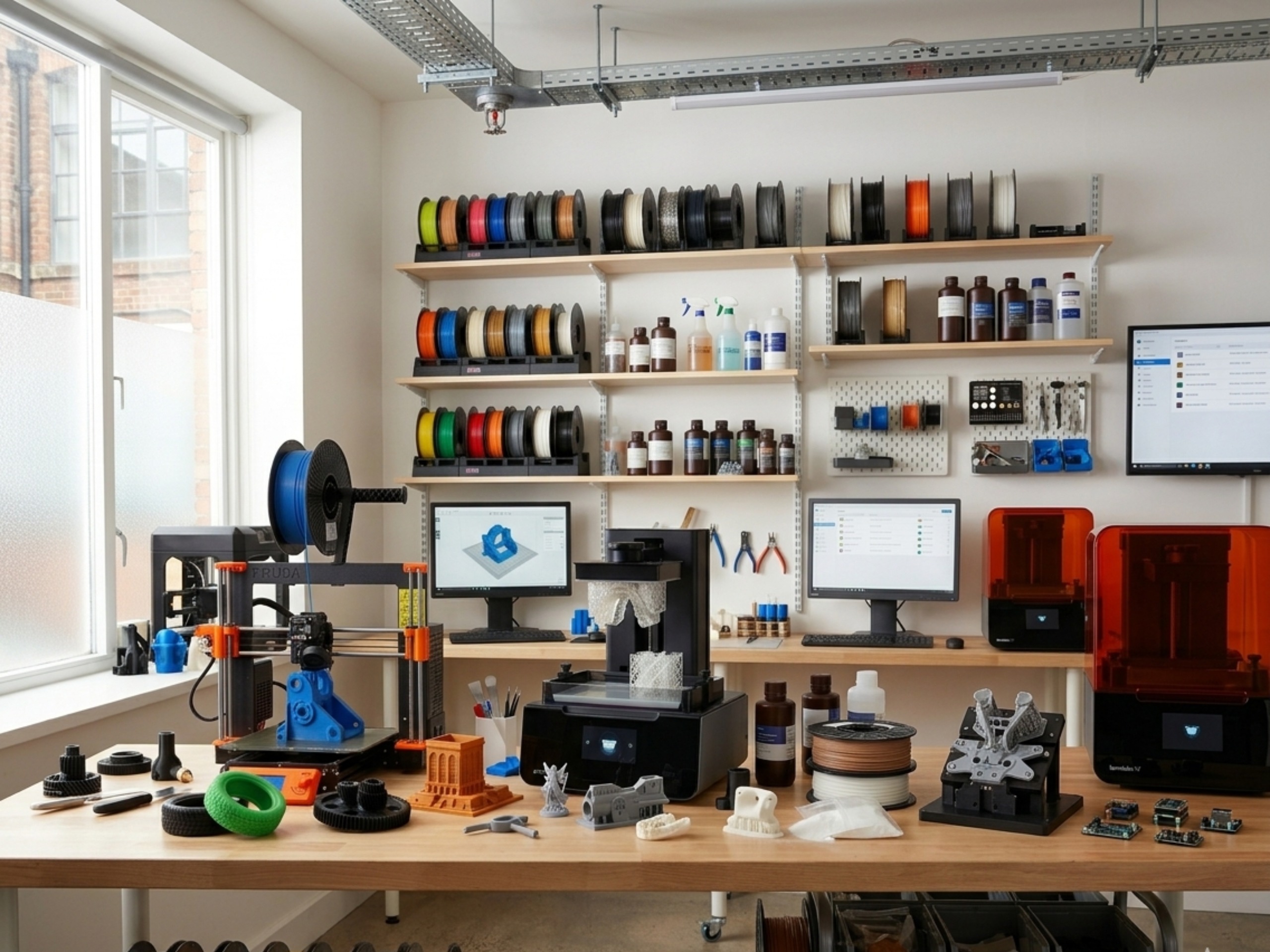
Starting with the appropriate technology will greatly facilitate your learning process if you are new to 3D scanning and printing specialist. Because FDM (Fused Deposition Modeling) is widely accessible, inexpensive, and easy to set up, it is typically the best choice for novices. You can prevent needless expenses and technical annoyances by selecting the appropriate printer type. Beginners can confidently begin their adventure and progressively advance their skills by learning the fundamentals and investigating the various forms of 3D printing service Malaysia.
Table of Contents:
Key Takeaways
- Because they are widely accessible, inexpensive, and simple to set up, FDM printers are the most user-friendly for novices.
- Based on your project’s objectives, select a printer. SLA is superior for high-detail prints, SLS is perfect for robust functioning parts, and FDM is good for generic models.
- Because PLA filament is dependable and simple to use, it is the ideal starting material.
- Before making a purchase, always take into account the initial cost of the printer as well as continuing material expenditures.
- You may learn more quickly and develop your printing abilities with the aid of beginner-friendly software and online communities.
Why the Right 3D Printing Type Matters
Cost and Accessibility
Cost and availability are important factors for novices when selecting a 3D printer. The most accessible and reasonably priced choice is usually an FDM printer. Entry-level models typically cost about $200, and the materials—like PLA filament—are cheap and simple to swap out. Additionally, FDM is a practical starting point for educators, students, and enthusiasts because to its comparatively easy maintenance.
Compared to FDM printers, SLA printers are often more costly and need liquid resin for printing. Compared to filament, resin is typically more expensive and necessitates additional equipment for the cleaning and curing of printed products. Because SLS printers are much more expensive and are primarily utilized in professional or industrial settings, they are not as appropriate for novices.
Print Quality and Application
The quality and level of detail produced by various 3D printing plastic process vary. For simple prototypes, side projects, and instructional models, FDM printers are perfect. The printed products may exhibit noticeable layer lines despite their dependability and versatility.
Smoother surfaces and finer features are produced using SLA printers. They are frequently used for dental models, jewelry designs, miniatures, and high-detail prototypes due to their accuracy. Strong and complicated pieces can be produced by SLS printers without the need for support structures. Because of this, they are helpful for engineering components and working prototypes, but the technology is typically more expensive and complex for novices.
The Different Types of 3D Printing
Comprehending the many forms of 3D printing technologies can assist novices in selecting the appropriate device for their requirements.
FDM (Fused Deposition Modeling)
The most popular 3D printing method for novices that 3D Printing Service Near Me use is FDM.To create an item, it melts plastic filament and deposits it layer by layer via a heated nozzle. The procedure is straightforward, dependable, and suitable for a variety of materials.
Users of FDM printers can modify parameters like printing speed, layer height, and temperature. These modifications aid in managing the trade-off between printing time and print quality. FDM is frequently used for prototypes, hobby models, educational projects, and simple product designs due to its price and simplicity of use.
SLA (Stereolithography)
UV light is used in SLA printing to cure liquid resin into solid layers. The printer creates smooth surfaces and great levels of detail by building items layer by layer with incredibly fine resolution.
Applications requiring precision, such tiny figurines, jewelry prototypes, dentistry models, and product design concepts, are perfect for this technology. Nevertheless, extra post-processing procedures like cleaning and curing the printed object are necessary for SLA printing. Safety measures and adequate workspace ventilation are also necessary when handling liquid resin.
SLS (Selective Laser Sintering)
SLS is a powder-based 3D printing method that fuses powdered materials layer by layer using a laser. One of its main benefits is that it does not require support structures because the surrounding powder maintains the structure during printing.
This process makes it possible to create intricate and long-lasting pieces that would be challenging to make using other technologies. SLS is frequently applied to industrial applications, mechanical components, and functional prototypes. However, it is typically not the first option for novices because of the expense of equipment and the difficulty of handling powdered materials.
Other Types of 3D Printers
Apart from the primary technologies, various other 3D printing techniques are employed in certain industries. PolyJet printing is capable of producing multi-color and multi-material things with extreme precision. A thermal printhead is used in place of a laser in Selective Heat Sintering (SHS), which functions similarly to SLS. By binding colored ink to powder materials, ColorJet Printing (CJP) produces full-color models. In industrial manufacturing, metal parts are printed using laser metal deposition (LMD), although professional prototyping frequently uses multi-jet modeling (MJM).
While these technologies have special features, they are typically more costly and complicated than FDM and SLA printers. Because of this, the majority of novices begin with FDM and, as they gain skill, investigate alternative technologies.
Pros and Cons of Types of 3D Printers
FDM
Because FDM printers are inexpensive, simple to set up, and compatible with a wide range of materials, they are frequently regarded as the ideal choice for novices. They are appropriate for routine printing jobs including models, prototypes, and basic functional components. Touchscreen controls, quicker printing speeds, and automatic calibration are just a few of the useful features found in many contemporary FDM printers.
Nevertheless, customers could encounter typical problems like apparent layer lines, print adhesion problems, or nozzle clogging. If the temperature settings are not ideal, some materials may also distort during printing.
SLA
SLA printers are renowned for their capacity to create smooth-surfaced, incredibly detailed prints. They work very well in applications where accuracy and appearance are crucial. SLA printers are frequently used by engineers, designers, and jewelers to develop prototypes.
SLA printers need extra handling procedures despite their benefits. Handling liquid resin requires caution, gloves, and adequate ventilation because it can get messy. Additionally, the materials may be more brittle than standard FDM filaments.
SLS
SLS printing is perfect for producing intricate, robust parts that need to last. Engineers are able to create complex internal structures and functional components since they can print without support structures.
But when it comes to handling powdered materials, SLS printers are more expensive, need more complicated maintenance, and require safety measures. Because of this, professionals rather than novices usually employ them.
3D Printing Materials for Beginners
For prints to be effective, choosing the appropriate material is crucial, particularly in the beginning.
Common Filaments: PLA, ABS, PETG
For novices, PLA is generally regarded as the best filament. It rarely warps, prints at comparatively low temperatures, and creates crisp, detailed prints. Prototypes, models, and instructional projects frequently employ PLA, which is also available in a variety of colors.
Another common filament that provides better strength and flexibility than PLA is PETG. Because of its increased durability and impact resistance, it is appropriate for functioning parts. PETG, however, necessitates improved ventilation and somewhat higher printing temperatures.
Although ABS can be more difficult to print, it is tougher and more heat resistant than PLA and PETG. To avoid warping, it often needs an enclosed printer and a heated bed. It’s crucial to have adequate ventilation when using ABS because it emits heavier odors.
Resin and Powder Options
UV light causes liquid resin materials used in SLA printers to solidify. Although these materials provide incredibly detailed prints, handling and post-processing must be done carefully.
Usually based on nylon, powder ingredients are utilized in SLS printers to create robust, long-lasting components. However, powder-based printing is less popular among novices because the handling procedure is more complicated and necessitates appropriate safety precautions.
How to Choose
Focusing on a few essential elements makes selecting your first 3D printer much simpler.
Define Your Goals
Determine what you want to make with your 3D printer first. An FDM printer is probably the ideal option if your objective is to print basic models, prototypes, or instructional projects. An SLA printer would be better appropriate if you want to make extremely precise objects like jewelry or miniatures.
Set Your Budget
When choosing a printer, budget is a big factor. For novices, entry-level FDM printers offer reasonable performance and are typically the most economical choice. Higher detail can be produced with SLA printers, but post-processing equipment and resin supplies are more expensive.
Consider Ease of Use
For novices, usability is a crucial consideration. Tinkercad, Ultimaker Cura, and PrusaSlicer are examples of beginner-friendly software that supports FDM printers, which are typically the easiest to use. Without requiring sophisticated technical knowledge, these tools assist users in creating models and getting files ready for printing.
Match Materials and Print Quality
Your print quality and project success will be directly impacted by the materials you select. For beginners, PLA is the most dependable beginning material. You can experiment with tougher or more flexible materials like PETG or TPU after you’re comfortable with the printing process.
Beginner Scenarios
Varied printer selections may result from varied starting aims. FDM printers with PLA filament are typically the best choice for basic models, toys, and prototypes. SLA printers offer more accuracy and smoother surfaces for intricate patterns or creative endeavors. Materials like PETG or ABS can offer increased durability if your objective is to produce stronger functioning pieces.
When beginning your 3D printing adventure, selecting the appropriate technology is crucial. Because they are inexpensive, simple to use, and backed by a sizable community, FDM printers are typically the ideal place to start. Depending on the needs of your project, you can experiment with various technologies like SLA or SLS as you gain experience. Beginners may swiftly advance their abilities and take use of the creative potential of 3D printing with the correct tools and assistance.
FAQ
Which 3D printer is the most user-friendly for a novice?
FDM printers are typically the simplest choice due to their low cost, ease of setup, and widespread support from online groups and tutorials.
Can novices use a variety of materials to print?
Sure. When they are more at ease with the printing process, most novices begin with PLA filament and progressively try additional materials like PETG or ABS.
Does creating 3D models require certain software?
Advanced software is not needed to get started. Tinkercad and Ultimaker Cura are two beginner-friendly programs that make it simple for users to design and prepare models for printing.
Is at-home 3D printing safe?
When simple safety measures are taken, 3D printing is safe. Maintain a tidy and orderly workspace and make sure there is adequate ventilation, particularly when working materials like ABS or resin.
Are you trying to find a trustworthy metal 3D printing service in Malaysia or advice from a reputable 3D printing company Malaysia? Whether you are beginning with simple prototype or looking into advanced production solutions, our staff is available to assist you in selecting the best 3D printing technology for your needs.
To find out more about 3D architectural modelling service, 3D printing methods, materials, suited to your projects, get in contact with us. We can assist you in selecting the best strategy for your operation, from industrial metal printing to solutions suitable for beginners.
